
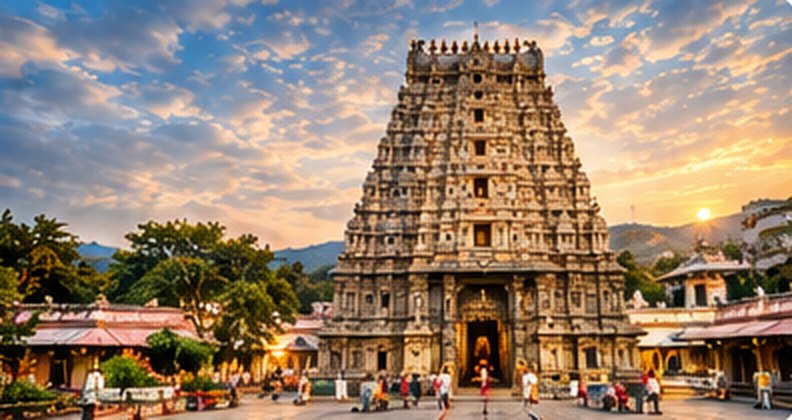
About the temple
Sri Kalahasteeswara Swamy Vari Devasthanam stands at Srikalahasti in Tirupati District, Andhra Pradesh, on the banks of the Swarnamukhi River. Known as Dakshina Kailasam, it is one of the five Pancha Bhuta Sthalams and represents Vayu, the element of air. It is also India's best-known centre for Rahu Ketu and Kalasarpa dosha nivarana pooja.
| Detail | Information |
|---|---|
| Main deity | Lord Kalahasteeswara (Shiva as the Vayu Linga) |
| Goddess | Gnana Prasunambika Devi |
| Location | Srikalahasti, Tirupati District, Andhra Pradesh 517644 |
| River | Swarnamukhi |
| Also known as | Dakshina Kailasam |
| Best known for | Rahu Ketu and Kalasarpa dosha nivarana pooja |
History
According to ancient Tamil sources, Srikalahasti has been known as the Kailas of the South for more than two thousand years, and the Swarnamukhi as the Ganges of the South. The inner temple dates to about the 5th century, and the outer temple was built in the 12th century by the Chola and Vijayanagara kings.
Over the centuries the temple grew into a large complex of shrines, pillared halls and gateways, and became a major pilgrimage centre of the Telugu and Tamil regions.
Ancient Tamil sources already know Srikalahasti as a great Shiva shrine and the Swarnamukhi as the Ganges of the South.
The inner sanctum is dated to around the 5th century.
The outer temple is built by the Chola kings, with later additions by the Vijayanagara kings.
The Vijayanagara king Krishnadevaraya is remembered for major additions.
Daily darshan, sevas and the Rahu Ketu Pooja draw devotees from across India.
Architecture
The temple follows the Dravidian style, with a tall rajagopuram, pillared mandapams and detailed stone carving. The main shrine faces west, which is unusual for a Shiva temple, and part of the complex is carved into the rocky hill beside it.
- Rajagopuram: the towering entrance gateway visible from across the town
- Pillared halls (mandapams) with sculpted figures
- Shrines for the Lord, the Goddess and many parivara deities
- The hill behind the temple, with the Kannappa and Durgamba shrines
Deities
The presiding deity is Lord Kalahasteeswara, worshipped as the Vayu Linga. Devotees say the lamps near the sanctum flicker steadily even though the inner shrine has no windows, which they take as a sign of the wind element. The Goddess is Gnana Prasunambika Devi. Other revered shrines include Pathala Ganapati and the Kannappa temple on the hill.
The legend of the name
The name joins three devotees: Sri (spider), Kala (serpent) and Hasti (elephant), who each worshipped Shiva here and attained liberation. The hunter-devotee Kannappa (Thinnadu), who offered his own eyes to the Lord, is also honoured at this temple.
Temple significance
Srikalahasti is one of five Shiva temples that each represent a classical element.
| Element | Temple |
|---|---|
| Prithvi (earth) | Ekambareswarar, Kanchipuram |
| Appu (water) | Jambukeswarar, Thiruvanaikaval |
| Tejas (fire) | Arunachaleswarar, Tiruvannamalai |
| Vayu (air) | Kalahasteeswara, Srikalahasti |
| Akasha (space) | Nataraja, Chidambaram |
Why Srikalahasti is special
Three things set this temple apart. It is the Vayu (air) Linga among the Pancha Bhuta temples, it is the best-known centre for Rahu Ketu pooja, and it keeps alive the story of Kannappa's devotion. The setting beside a hill and the Swarnamukhi river adds to the experience.
Temple etiquette
- Dress modestly in traditional clothes
- Remove footwear before entering
- Keep your phone silent and avoid photography in the sanctum
- Follow the queue lines and staff instructions
- Do not carry large bags or leather items inside
Glossary of temple terms
| Term | Meaning |
|---|---|
| Devasthanam | The administration that runs the temple |
| Darshan | Seeing and being seen by the deity |
| Abhishekam | Ritual bathing of the deity with sacred offerings |
| Sankalpam | A resolve recited by the devotee at the start of a pooja |
| Prasadam | A blessed offering returned to the devotee |
| Gopuram | The tall gateway tower of a temple |
| Mandapam | A pillared hall |
| Rahu Kalam | A daily period of about 90 minutes linked to Rahu |
| Pradosha | The twilight period observed for Shiva worship |
| Pancha Bhuta Sthalam | One of five Shiva temples linked to the five elements |